

✍️ CONTENT
The United States Department of Defense is expanding autonomous drone swarm testing as part of large-scale military exercises in the Pacific region. The initiative reflects growing strategic interest in coordinated unmanned systems capable of operating collaboratively in complex operational environments.
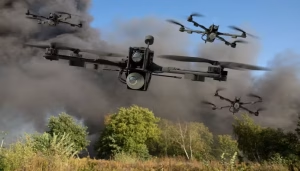
Drone swarm technologies allow multiple unmanned aerial systems to communicate, coordinate, and execute mission objectives without continuous human control. These systems rely on artificial intelligence algorithms and distributed communication networks to maintain formation, adapt to dynamic threats, and conduct surveillance or strike operations.
Pacific exercises provide an ideal operational environment for testing swarm coordination in contested and multi-domain scenarios. Defense planners are particularly interested in the potential of drone swarms to overwhelm traditional air defense systems and provide persistent reconnaissance coverage.
The growing focus on autonomous swarm operations signals a broader transformation in modern warfare doctrine. Rather than relying solely on high-value individual platforms, military strategists are increasingly exploring distributed and scalable unmanned systems capable of operating in coordinated formations.
As drone swarm technologies continue to mature, they are expected to play an increasingly central role in future military operations, particularly within maritime and island-based operational theaters such as the Indo-Pacific region.
UAV Intelligence will continue monitoring developments in autonomous swarm warfare and next-generation unmanned operational concepts.
The U.S. Department of Defense (DoD) has intensified autonomous drone swarm testing during its latest Pacific military exercises, marking a significant evolution in AI-enabled force coordination strategies.
According to defense officials, the expanded trials focus on real-time distributed decision-making systems that allow multiple unmanned aerial vehicles (UAVs) to operate collaboratively without centralized command dependency.

Strategic Objectives
The swarm platforms are being evaluated for:
-
Autonomous target allocation
-
Dynamic threat response
-
Electronic warfare resistance
-
Maritime surveillance operations
Defense analysts indicate that the Pacific theater serves as a strategic testing ground due to its complex operational environment and growing geopolitical tensions.
AI and Tactical Coordination
The latest generation swarm systems incorporate machine-learning algorithms capable of adaptive behavior in contested electromagnetic environments.
Unlike traditional UAV formations, these systems distribute mission logic across nodes, reducing vulnerability to single-point failures.
Strategic Implications
The expansion of drone swarm doctrine represents a structural shift in military planning. Instead of platform-centric force projection, modern doctrine increasingly favors distributed autonomous networks capable of saturating and overwhelming adversary defenses.
🧭 UAV Intelligence will continue monitoring developments in AI-driven swarm deployment within Indo-Pacific defense strategies.

— Analysis by Gurkan Bal
Founder & Editor | UAV Intelligence