

✍️ CONTENT
Autonomous combat drones are rapidly transforming air superiority doctrine in modern warfare environments.
The rapid evolution of autonomous combat drones is fundamentally redefining traditional air superiority doctrine. What was once dominated by crewed fighter aircraft is now transitioning toward hybrid and fully autonomous aerial combat architectures.
For decades, air superiority depended on advanced pilot training, high-performance aircraft platforms, and centralized command structures. Today, algorithm-driven combat systems are beginning to challenge those assumptions.
From Pilot-Centric to Algorithm-Centric Warfare
Autonomous combat UAVs equipped with AI-based targeting and maneuver optimization systems can process battlefield variables faster than human operators.
These systems enable:
-
Real-time adaptive engagement strategies
-
Swarm-enabled distributed combat
-
Reduced pilot risk exposure
-
Persistent contested airspace presence
The shift is not merely technological — it is doctrinal.
Air dominance may increasingly depend on machine-speed decision cycles rather than human reaction capability.
Cost Asymmetry and Force Multiplication
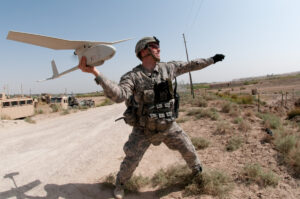
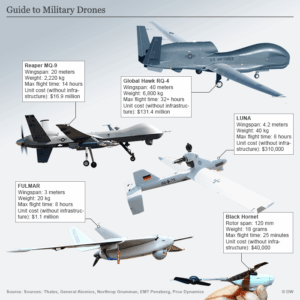
Autonomous UAV platforms present a cost-efficiency advantage compared to traditional fifth-generation fighter aircraft.
Key advantages include:
-
Lower production costs
-
Modular payload adaptability
-
Reduced logistical footprint
-
Scalable deployment capacity
This creates a force multiplication effect, allowing smaller defense budgets to field distributed aerial capabilities that challenge conventional air power hierarchies.
Vulnerabilities and Ethical Considerations
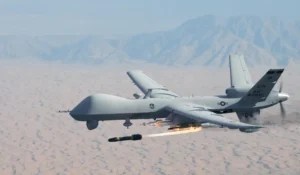
Despite strategic advantages, autonomous combat drones introduce critical concerns:
-
AI decision reliability under contested electronic warfare
-
Escalation risks in automated engagements
-
Accountability in lethal autonomous operations
Nations integrating these systems must balance operational speed with robust oversight mechanisms.
Strategic Implications for Global Power Balance
The proliferation of autonomous combat drones signals a structural transformation in global airpower dynamics.
Air superiority may no longer be determined solely by high-end fighter fleets, but by:
-
AI integration maturity
-
Swarm doctrine sophistication
-
Counter-autonomy resilience
As algorithmic warfare capabilities expand, future conflict environments will increasingly reflect machine-driven engagement cycles.
Autonomous combat drones are not replacing traditional aircraft — they are redefining the architecture of air dominance itself.
Doctrinal Outlook
As autonomous combat integration matures, air superiority frameworks will increasingly depend on algorithmic coordination layers rather than solely platform performance metrics.
🧭 UAV Intelligence will continue analyzing the evolving intersection of autonomy, AI-driven warfare, and global airpower transformation.
— Analysis by Gurkan Bal
Founder & Editor | UAV Intelligence