


New SHGM Draft Regulation Signals Major Changes for the UAV Industry
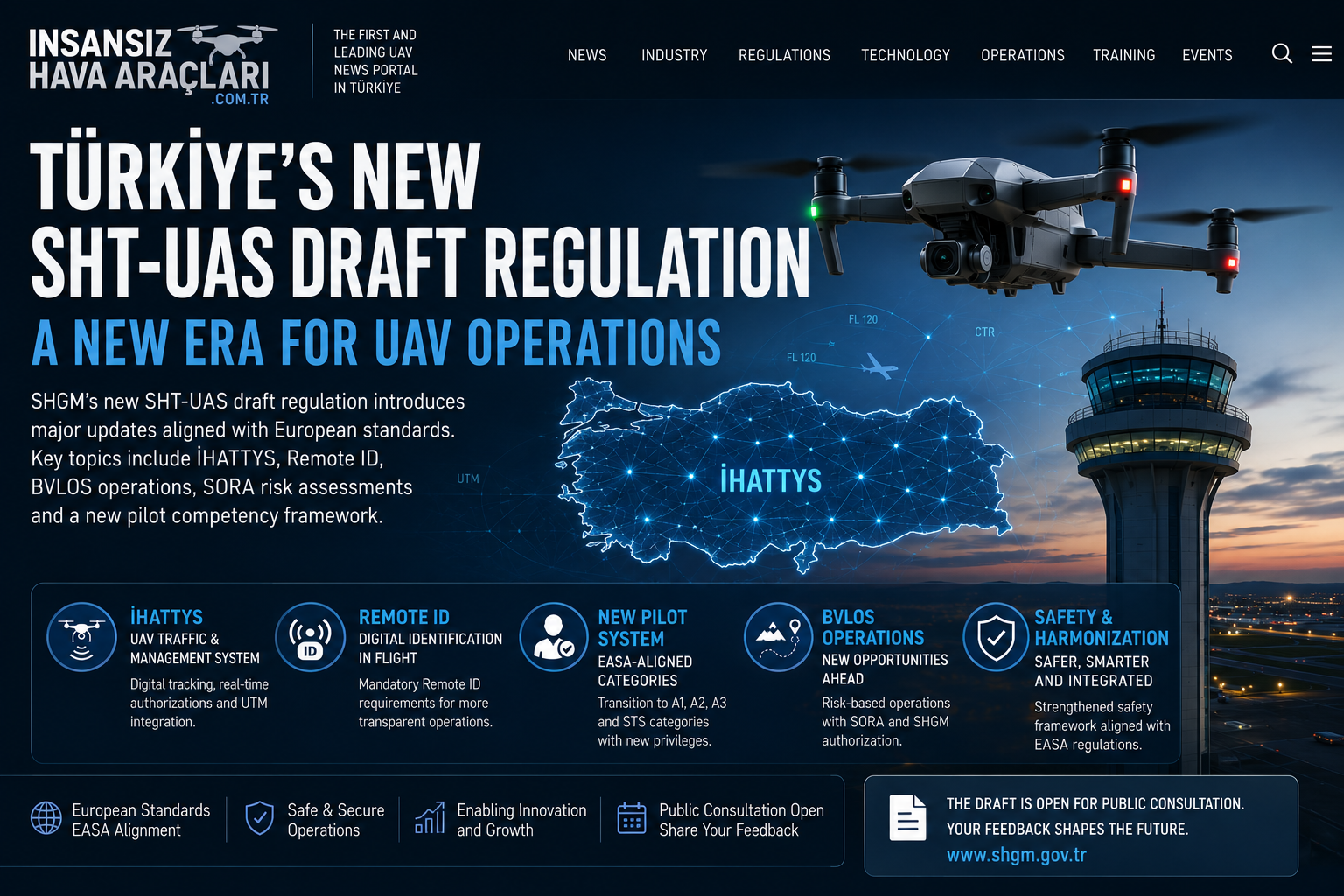
ANKARA, Türkiye – The Directorate General of Civil Aviation (SHGM) has opened a new Unmanned Aircraft Systems Regulation (SHT-UAS Draft) for public consultation, introducing what could become the most comprehensive regulatory reform in Türkiye’s drone sector in recent years.
The draft regulation proposes significant updates covering drone registration, remote pilot certification, operational authorizations, airspace management, digital tracking systems, and future autonomous operations.
Among the most notable developments are the introduction of the Unmanned Aircraft Tracking and Traffic Management System (İHATTYS), expanded Remote ID requirements, and a new certification framework aligned with European Union aviation standards.
Towards a Safer and More Integrated Airspace
According to SHGM, the primary objective of the draft is to ensure that unmanned aircraft operations within Turkish airspace are conducted in a safer, more traceable, and internationally harmonized manner.
The rapid growth of:
- Commercial drone operations,
- Agricultural spraying missions,
- Surveying and mapping activities,
- Infrastructure inspections,
- Media and film production,
- Search and rescue missions,
has significantly increased drone traffic across the country.
As drones increasingly share airspace with commercial aircraft, helicopters, firefighting aircraft, air ambulances, and military platforms, authorities are seeking more advanced traffic management capabilities.
İHATTYS: A New Digital Traffic Management Platform
One of the draft’s most important innovations is the Unmanned Aircraft Tracking and Traffic Management System (İHATTYS).
The system is designed to provide centralized management of drone traffic throughout Türkiye by enabling:
- Registration and monitoring of UAV operations,
- Digital flight authorization processes,
- Real-time airspace restriction updates,
- Traffic conflict detection,
- Operational alerts for drone operators.
Industry experts believe that İHATTYS could also serve as a foundational infrastructure for future eVTOL air taxi services and advanced drone logistics networks.
Remote ID Requirements May Expand
The draft regulation introduces provisions that could expand the use of Remote Identification (Remote ID) technologies.
Remote ID systems allow drones to broadcast:
- Identification information,
- Position data,
- Altitude,
- Operational status,
during flight.
While implementation details will be determined in future SHGM guidance, legacy drone platforms without class labels may eventually be required to adopt Remote ID solutions.
Existing Pilot Certification System to Be Transformed
The draft also proposes a transition from Türkiye’s current drone certification structure toward a European-style competency framework.
Current certificates:
- UAV-0
- UAV-1
- UAV-2
- UAV-3
are expected to be converted into new operational categories aligned with European regulations, including:
- A1
- A2
- A3
- STS (Standard Scenarios)
SHGM is expected to publish a detailed transition roadmap in the coming period.
Five-Year Validity for Remote Pilot Certificates
Under the proposed framework, remote pilot competency certificates will no longer remain valid indefinitely.
Instead:
- Certificates will remain valid for five years.
- Renewal will require refresher training or successful completion of examinations.
This approach mirrors current European regulatory practices.
New Opportunities for BVLOS Operations
The draft provides a clearer regulatory foundation for Beyond Visual Line of Sight (BVLOS) operations.
The new framework could support future growth in:
- Agricultural drone applications,
- Long-range infrastructure inspections,
- Cargo drone services,
- Emergency response missions,
- Critical infrastructure monitoring.
However, operators will be required to complete operational risk assessments using methodologies such as SORA (Specific Operations Risk Assessment) and obtain SHGM authorization where applicable.
Autonomous and AI-Based Operations
The regulation also addresses artificial intelligence and fully autonomous flight systems.
According to the draft, SHGM plans to introduce a separate regulatory framework governing AI-enabled autonomous operations.
Until such regulations are published, commercial operations using fully autonomous AI-controlled systems will not be permitted.
Expanded Role for Disaster Response Operations
Special provisions have also been included for disaster and emergency response operations.
Authorized civilian drone operators may support:
- AFAD (Disaster and Emergency Management Authority),
- Provincial emergency units,
- Public authorities,
during emergency situations under coordinated operational frameworks.
The draft introduces the concept of a registered “Disaster Support Operator”, allowing qualified civilian operators to contribute to emergency response missions more effectively.
A New Era for Türkiye’s Drone Industry
Industry observers emphasize that the proposed regulation is not intended to restrict drone usage but rather to create a more professional, scalable, and internationally compatible ecosystem.
If adopted, the new framework will accelerate the development of:
- Digital airspace management,
- Remote Identification technologies,
- European-standard pilot certification,
- BVLOS operations,
- Advanced unmanned traffic management systems.
The draft regulation remains under public consultation, and stakeholders across the drone industry are closely monitoring future revisions and implementation timelines.
Source: SHGM Draft Unmanned Aircraft Systems Regulation (SHT-UAS), EASA Regulations 2019/947 and 2019/945.
Editorial Note: This article is based on the draft regulation published by SHGM for public consultation. The final regulatory text may be amended following stakeholder feedback before entering into force.
Analysis by Gürkan Bal
Founder & Editor, UAV Intelligence
Aviation, UAV Systems & Air Mobility Analyst