


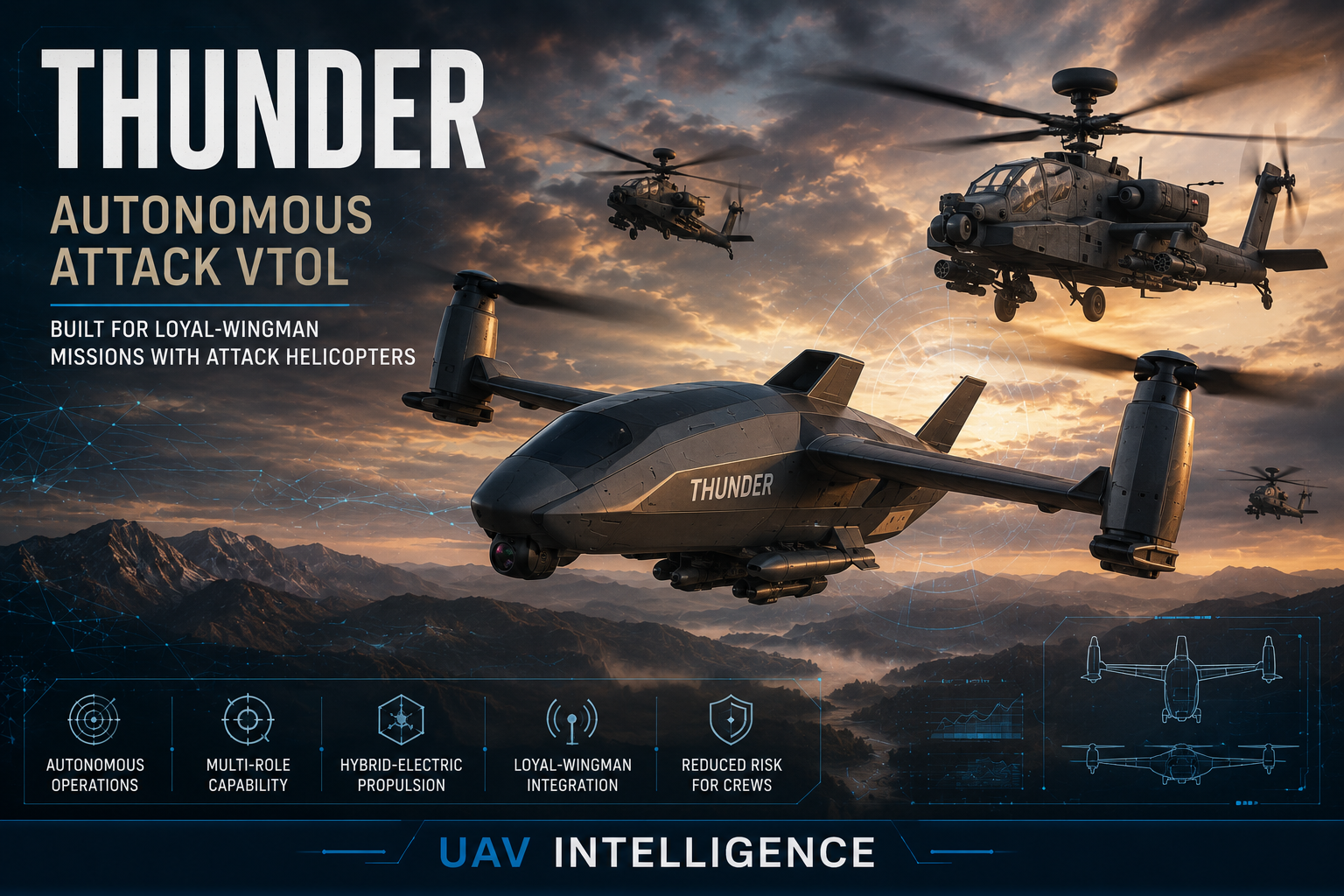
Anduril Industries and Archer Aviation have unveiled Thunder, a new Group 5 autonomous attack rotorcraft designed to operate alongside crewed military helicopters.
The aircraft was presented at the Farnborough International Airshow as the defence configuration of a jointly developed hybrid-electric vertical take-off and landing platform.
Thunder is intended to support current and future attack and assault helicopters by carrying weapons, sensors, communications systems or other mission payloads into high-risk operational environments.
The platform combines vertical take-off capability with wing-borne flight, allowing it to operate without conventional runways while achieving longer range than traditional multirotor aircraft.
According to the developers, Thunder can be controlled from the ground or integrated into missions involving crewed aircraft. Its autonomous systems are intended to reduce pilot workload and enable coordinated operations between human-operated and uncrewed platforms.
The aircraft is positioned for missions including armed reconnaissance, electronic warfare, strike support, logistics and the deployment of smaller unmanned systems.
Thunder is also associated with the United Kingdom’s Project NYX, which is examining autonomous aircraft capable of operating with the British Army’s Apache attack helicopters.
The platform is expected to begin flight testing in 2027.
UAV INTELLIGENCE ASSESSMENT:
Thunder demonstrates how the collaborative combat aircraft concept is expanding beyond fast jets and into the rotary-wing domain.
Autonomous aircraft operating alongside attack helicopters could extend sensor reach, increase available firepower and reduce human exposure in heavily defended areas.
The platform’s long-term success will depend on flight-test performance, weapons integration, survivability, procurement cost and the maturity of its autonomous mission-management system.
VERIFICATION:
Official + Multi-Source
PRIMARY SOURCES:
Anduril and Archer Aviation
SUPPORTING SOURCE:
Financial Times
SOURCE DATE:
20 July 2026
DOCUMENT ID: UAV-2607-UIN-003
— Analysis by Gurkan Bal
Founder & Editor | UAV Intelligence