


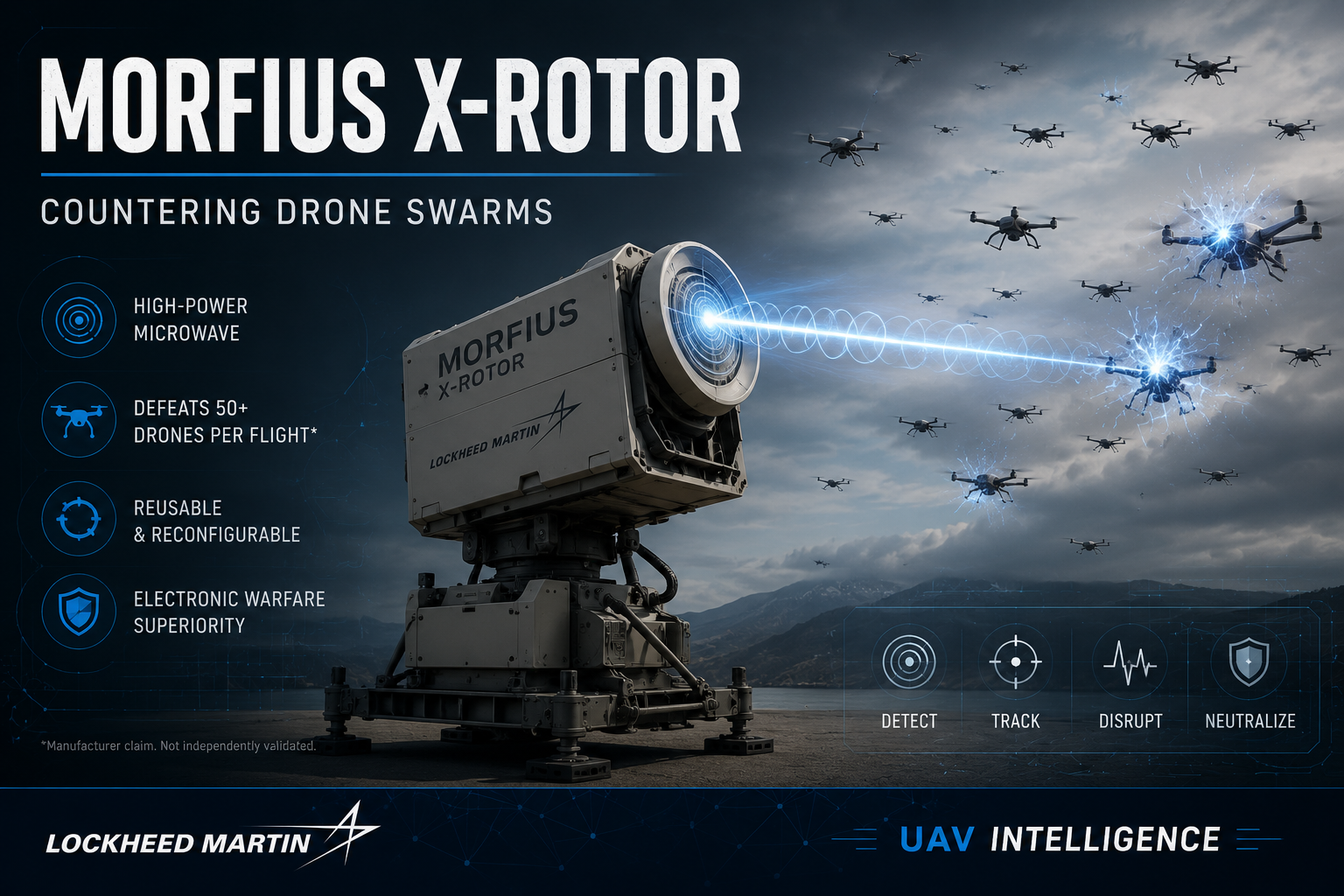
MORFIUS X-Rotor Targets Large Drone Swarms With High-Power Microwaves
Lockheed Martin says its reusable airborne counter-UAS system can neutralise more than 50 hostile drones during a single flight.
Lockheed Martin has unveiled MORFIUS X-Rotor, a reusable airborne counter-drone system developed to combat large formations of hostile unmanned aircraft using high-power microwave technology.
Introduced during the 2026 Farnborough International Airshow in England, MORFIUS X-Rotor is described by the company as a “one-to-many” counter-unmanned aircraft system. Instead of launching a separate interceptor missile against every incoming drone, the platform is designed to use a high-power microwave effector against multiple electronic targets during a single mission.
According to Lockheed Martin, MORFIUS X-Rotor can neutralise more than 50 hostile drones in one flight. This performance figure is a manufacturer claim and has not yet been independently validated through publicly available operational testing.
What Is MORFIUS X-Rotor?
MORFIUS X-Rotor is a ground-launched airborne counter-UAS platform designed to detect, approach and disrupt hostile unmanned aircraft formations.
The system carries a compact high-power microwave payload. Microwave energy can affect the electronic components used by unmanned aircraft, including flight-control systems, communications equipment, navigation electronics and onboard processors.
This gives MORFIUS a fundamentally different engagement model from conventional kinetic air-defence systems.
Traditional counter-drone interceptors normally require one missile, projectile or other munition for every target. A high-power microwave system may potentially affect several electronically dependent targets within its effective engagement area.
Lockheed Martin therefore presents MORFIUS X-Rotor as a reusable and lower-cost-per-engagement option for countering mass drone attacks.
Designed for Field Recovery and Reuse
One of the system’s defining features is its planned field recoverability.
Lockheed Martin says MORFIUS X-Rotor can be recovered after a mission, reconfigured and returned to service. Reusability could reduce the cost of repeated engagements, particularly when defensive forces are facing large quantities of comparatively inexpensive commercial or military drones.
The platform is also described as sensor-agnostic and command-and-control-agnostic. This means MORFIUS is intended to operate with different detection networks and command architectures rather than relying on a single proprietary radar or fire-control system.
The company says the system does not require a dedicated sensor to guide it to an engagement. That could make integration easier within layered air-defence networks that already combine radar, electro-optical sensors, electronic warfare systems and command-and-control platforms.
Why Drone Swarms Are Changing Air Defence
Large drone formations are creating a serious economic and operational challenge for modern air-defence forces.
Small unmanned aircraft can be produced and deployed at significantly lower cost than many conventional interceptor missiles. An attacker may therefore use large numbers of drones to overwhelm defensive sensors, exhaust available interceptors or force defenders to spend expensive weapons against low-cost targets.
This creates an unfavourable cost-exchange ratio.
Even when an air-defence system successfully destroys every incoming drone, the defender may still face a financial and logistical disadvantage if each engagement consumes a costly single-use interceptor.
Directed-energy and high-power microwave systems are being developed partly to change this equation. Their potential advantage lies in engaging multiple electronic targets while reducing dependence on individual missiles.
However, their actual effectiveness will depend on several operational factors, including range, available power, atmospheric conditions, target dispersion, electronic hardening and resistance to electromagnetic effects.
Part of a Layered Counter-UAS Architecture
MORFIUS is not intended to replace every other counter-drone capability.
Lockheed Martin positions the platform as one component of a layered counter-UAS architecture incorporating detection sensors, command-and-control software, electronic warfare systems, directed-energy effectors and kinetic interceptors.
Layered defence is particularly important because hostile drones may use different communications systems, navigation methods, autonomy levels, speeds and flight profiles.
Some drones may be vulnerable to communications jamming. Others may continue their missions using inertial navigation, terrain recognition or pre-programmed autonomous flight.
A diversified defence network gives operators several potential response options rather than depending on a single detection or interception method.
Development and Testing
MORFIUS technology has been under development for several years. Lockheed Martin states that earlier variants have conducted flight activity since 2017.
The company is accelerating production of MORFIUS prototypes and its high-power microwave payload. Additional testing is also planned following earlier trials conducted under different flight, interception and lethality conditions.
The next critical phase will be demonstrating repeatable performance under realistic operational conditions.
Independent evaluation will need to determine whether the system can maintain effectiveness against dispersed formations, hardened electronics, autonomous navigation, electronic countermeasures and rapidly changing swarm tactics.
UAV Intelligence Assessment
MORFIUS X-Rotor reflects the accelerating shift from one-to-one drone interception toward scalable one-to-many counter-swarm defence.
Its potential strategic value lies in its reusable architecture, high-power microwave payload and compatibility with different sensor and command networks.
If the system can reliably engage multiple drones without requiring an expensive interceptor for each target, it could improve the economics of defending military formations, air bases, critical infrastructure and strategic facilities against mass unmanned attacks.
However, the headline claim of more than 50 drone neutralisations per flight should presently be treated as a manufacturer-stated capability rather than an independently confirmed operational result.
The most important performance questions concern effective engagement range, target density, electronic hardening, resilience against countermeasures, recovery rates and sustained sortie generation.
MORFIUS X-Rotor is therefore a significant counter-UAS development, but its ultimate operational value will depend on transparent testing, military evaluation and successful integration into layered air-defence systems.
EDITORIAL NOTE
The stated capability to neutralise more than 50 drones during a single flight is based on information released by Lockheed Martin. UAV Intelligence has not identified an independent operational test publicly validating this figure.
DOCUMENT ID: UAV-2607-UIN-002
VERIFICATION: Official + Multi-Source
SOURCE DATE: 20 July 2026
— Analysis by Gurkan Bal
Founder & Editor | UAV Intelligence