


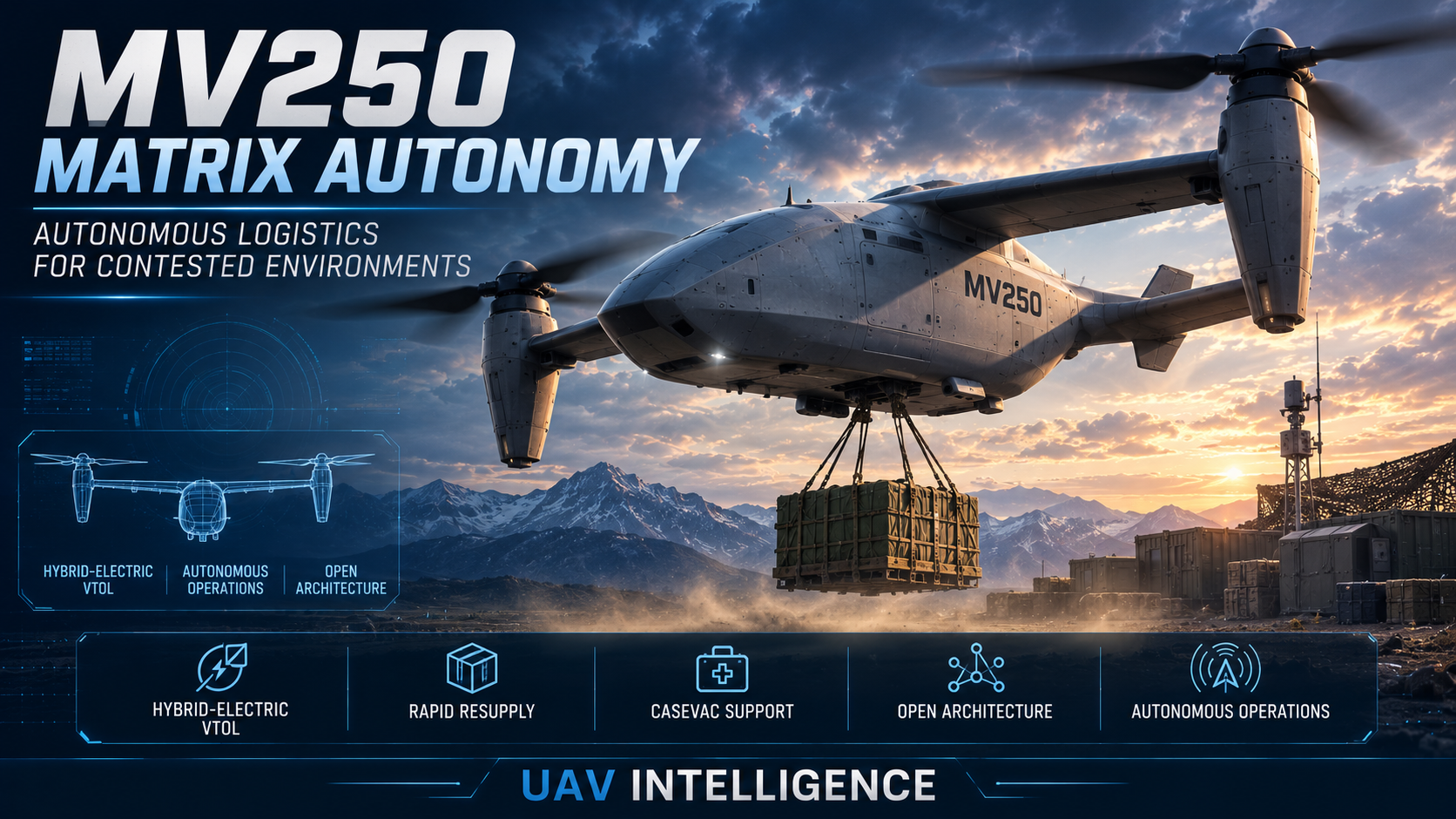
Sikorsky Integrates MATRIX Autonomy Into BETA Technologies’ MV250
The autonomous hybrid-electric VTOL aircraft is being developed for contested logistics, rapid resupply, casualty evacuation and other high-risk military missions.
Sikorsky and BETA Technologies are integrating the MATRIX autonomy suite into the MV250, a hybrid-electric vertical take-off and landing aircraft designed for autonomous military logistics in contested environments.
The collaboration was announced at the 2026 Farnborough International Airshow. Sikorsky, a Lockheed Martin company, said the MV250 will become the newest aircraft to join its expanding family of MATRIX-enabled autonomous platforms.
The programme combines BETA Technologies’ hybrid-electric ALIA aircraft architecture with Sikorsky’s autonomous flight-control and mission-management technology.
According to the companies, the MV250 is intended to perform rapid resupply, contested logistics, casualty evacuation and other high-tempo missions without exposing flight crews to unnecessary operational risk.
MATRIX Autonomy Already Flying on a BETA Test Aircraft
The two companies formally agreed to the integration initiative in July 2026.
Within approximately two weeks, the MATRIX autonomy suite was integrated into and flown aboard BETA Technologies’ CX300 conventional take-off and landing aircraft. The CX300 is being used as a test platform supporting development of the autonomous MV250.
This rapid integration was facilitated by the common flight-control architecture used across BETA’s ALIA family and the open-architecture design of the MATRIX autonomy system.
Flight testing will now continue to expand the aircraft’s autonomous flight envelope and assess the reliability of MATRIX when paired with BETA Technologies’ internally developed flight-control system.
The companies have not yet disclosed a complete operational test schedule or a target date for initial military service.
What Is the BETA MV250?
The MV250 is an autonomous hybrid-electric VTOL aircraft derived from BETA Technologies’ ALIA family.
It is being positioned as a medium-lift uncrewed logistics platform capable of carrying cargo into areas where conventional transport aircraft or crewed helicopters may face unacceptable operational risks.
The aircraft is designed to take off and land vertically, reducing dependence on conventional runways or major air bases. It can therefore support distributed military forces operating from dispersed or minimally prepared locations.
After transitioning from vertical take-off to wing-borne flight, the MV250 is expected to achieve greater range and speed than conventional multirotor logistics drones.
BETA Technologies describes the aircraft as a lower-cost and comparatively simple platform designed specifically for autonomous integration.
The MV250 uses a hybrid-electric powertrain rather than the fully electric architecture associated with some of BETA’s commercial aircraft. This configuration is intended to provide the endurance and operational flexibility required for military missions.
Addressing the Middleweight Logistics Gap
The developers position the MV250 as a response to what they describe as a middleweight military logistics gap.
Many existing small drones cannot carry enough cargo to support distributed military units effectively. At the other end of the spectrum, larger crewed helicopters and transport aircraft can deliver substantial payloads but are more expensive to operate and may place personnel at risk in heavily contested airspace.
The MV250 is intended to operate between these two categories.
Its proposed mission set includes:
- Rapid battlefield resupply
- Cargo movement between distributed operating locations
- Casualty evacuation support
- Medical supply delivery
- High-tempo logistics
- Operations from damaged or unavailable airfields
- Support for expeditionary and maritime forces
Aviation International News reported that the aircraft is expected to carry payloads of up to approximately 2,000 pounds, although detailed production specifications and mission-dependent performance figures remain subject to development and testing.
How MATRIX Autonomy Works
MATRIX is Sikorsky’s modular autonomy suite for rotary-wing and fixed-wing aircraft.
The technology is designed to support aircraft operating with pilots, without pilots or in optionally piloted configurations, depending on mission requirements.
MATRIX can provide automated flight planning, route management, obstacle avoidance, landing-zone evaluation and mission execution.
Aircraft equipped with MATRIX can also be controlled through a common operator interface. Sikorsky says this could allow operators to manage different autonomous aircraft types using a consistent command system rather than requiring a completely separate control architecture for each platform.
The system has already been demonstrated on several Sikorsky aircraft and is associated with platforms including the optionally piloted Black Hawk, the S-70UAS U-Hawk and the Nomad VTOL unmanned aircraft.
MATRIX technology also forms the core of the DARPA Aircrew Labor In-Cockpit Automation System programme, known as ALIAS.
Open Architecture and Multi-Mission Integration
The MV250 is being developed using a Modular Open Systems Approach.
This is intended to simplify the integration of autonomy software, communications equipment, payloads and mission systems supplied by different manufacturers.
An open architecture can also allow the aircraft to evolve without requiring a complete redesign whenever new sensors, datalinks or autonomous functions become available.
This is particularly important for military users because communications networks, electronic-warfare threats and mission requirements may change more rapidly than the airframe itself.
The combination of a common ALIA flight-control architecture and the open MATRIX autonomy suite contributed to the rapid initial integration demonstrated on the CX300 test aircraft.
However, successful integration during an early test campaign does not by itself confirm full operational maturity. Additional work will be required to validate the system under degraded communications, adverse weather, GPS-denied conditions and hostile electronic-warfare environments.
Contested Logistics as a Strategic Priority
Modern military forces are placing greater emphasis on distributed operations.
Instead of concentrating aircraft, personnel and supplies at a small number of large bases, forces may disperse across multiple operating locations to reduce vulnerability to missile, drone and air attacks.
This model increases the complexity of logistics.
Fuel, ammunition, medical supplies, spare parts and other critical material must be moved frequently between locations that may not have prepared runways or permanent infrastructure.
Crewed helicopters can perform these missions, but they require trained personnel and may be exposed to air-defence systems, electronic warfare and indirect fire.
Autonomous logistics aircraft could reduce some of this exposure by performing high-risk missions without crews aboard.
This does not eliminate operational risk. The aircraft may still be intercepted, jammed or destroyed. However, the loss of an uncrewed aircraft would not necessarily involve the loss or capture of flight personnel.
A Growing MATRIX-Enabled Aircraft Family
The MV250 is joining a broader group of aircraft equipped or planned to be equipped with MATRIX autonomy.
This family includes:
- Sikorsky OPV Black Hawk
- Sikorsky S-70UAS U-Hawk
- Sikorsky Nomad VTOL UAS
- BETA Technologies MV250
- BETA Technologies CX300 test aircraft
The use of a common autonomy suite across different aircraft categories could simplify operator training, command-system integration and fleet management.
It may also enable military customers to select different airframes for different payload and mission requirements while retaining a common autonomous operating environment.
UAV Intelligence Assessment
The integration of MATRIX autonomy into the MV250 reflects a broader shift in military aviation from individually controlled unmanned aircraft toward scalable autonomous logistics fleets.
The programme is strategically significant because it combines three technologies that are increasingly important to future military operations: vertical take-off and landing, hybrid-electric propulsion and mission-level autonomy.
The MV250 is not being developed primarily as a combat aircraft. Its initial value lies in logistics.
However, logistics platforms can have direct battlefield effects. Units that cannot receive ammunition, fuel, medical supplies or replacement components cannot maintain combat operations, regardless of the sophistication of their weapons.
Autonomous aircraft capable of operating from dispersed locations could therefore become a critical component of force survivability.
The open-architecture approach is another important feature. Military organisations increasingly want to avoid closed systems that tie aircraft, payloads and control software to a single manufacturer. MATRIX integration may allow the MV250 to operate within broader command-and-control networks while supporting future payload and mission-system upgrades.
The central technical issue will be whether the aircraft can maintain safe and reliable autonomous operations when satellite navigation, communications and datalinks are degraded or denied.
Contested logistics requires more than autonomous take-off and landing. The aircraft must also respond to changing threats, identify alternative routes, evaluate landing zones and continue or abort missions safely when communications with human operators are interrupted.
The programme’s long-term value will therefore depend on operational flight testing rather than the speed of its initial software integration.
Payload capacity, range, survivability, acoustic signature, maintenance requirements and procurement cost will also influence whether the MV250 can compete with conventional helicopters and other autonomous cargo-aircraft programmes.
Nevertheless, the Sikorsky–BETA collaboration provides a credible combination of an established autonomy system and a commercially derived aircraft architecture.
If flight testing confirms the required reliability, the MV250 could become an important middleweight platform for autonomous resupply, casualty evacuation and distributed military logistics.
Strategic Outlook
The MV250 demonstrates how technologies originally associated with advanced air mobility are moving into defence applications.
Commercial investment in electric and hybrid-electric aircraft can reduce the development burden for military platforms by providing mature airframes, propulsion systems and manufacturing processes.
Military customers can then add secure communications, autonomous mission-management systems and mission-specific payloads.
This dual-use development model may allow aircraft such as the MV250 to reach operational evaluation faster and at lower development cost than a platform designed entirely through a traditional military acquisition programme.
For NATO and allied forces, autonomous logistics platforms could support dispersed operations across Europe, the Arctic and the Indo-Pacific.
The Indo-Pacific is particularly relevant because forces may need to resupply isolated units across large distances while operating from islands, ships and damaged airfields.
The MV250’s success will ultimately depend on whether it can demonstrate a favourable cost-per-mission compared with crewed helicopters, ground transport and competing unmanned logistics aircraft.
The initial CX300 integration proves that MATRIX can be connected rapidly to BETA’s flight-control architecture. The next stage must demonstrate that the resulting system can perform complex logistics missions reliably under realistic operational pressure.
Key Takeaways
- Sikorsky will integrate MATRIX autonomy into BETA Technologies’ MV250 hybrid-electric VTOL aircraft.
- MATRIX was integrated and flown on a BETA CX300 test aircraft within approximately two weeks of the formal agreement.
- The MV250 is designed for contested logistics, rapid resupply, casualty evacuation and high-risk military missions.
- The aircraft combines vertical take-off capability with efficient wing-borne flight.
- The programme uses an open architecture intended to support rapid integration of autonomy and mission systems.
- Operational effectiveness under GPS-denied, communications-degraded and electronically contested conditions remains to be demonstrated.


