

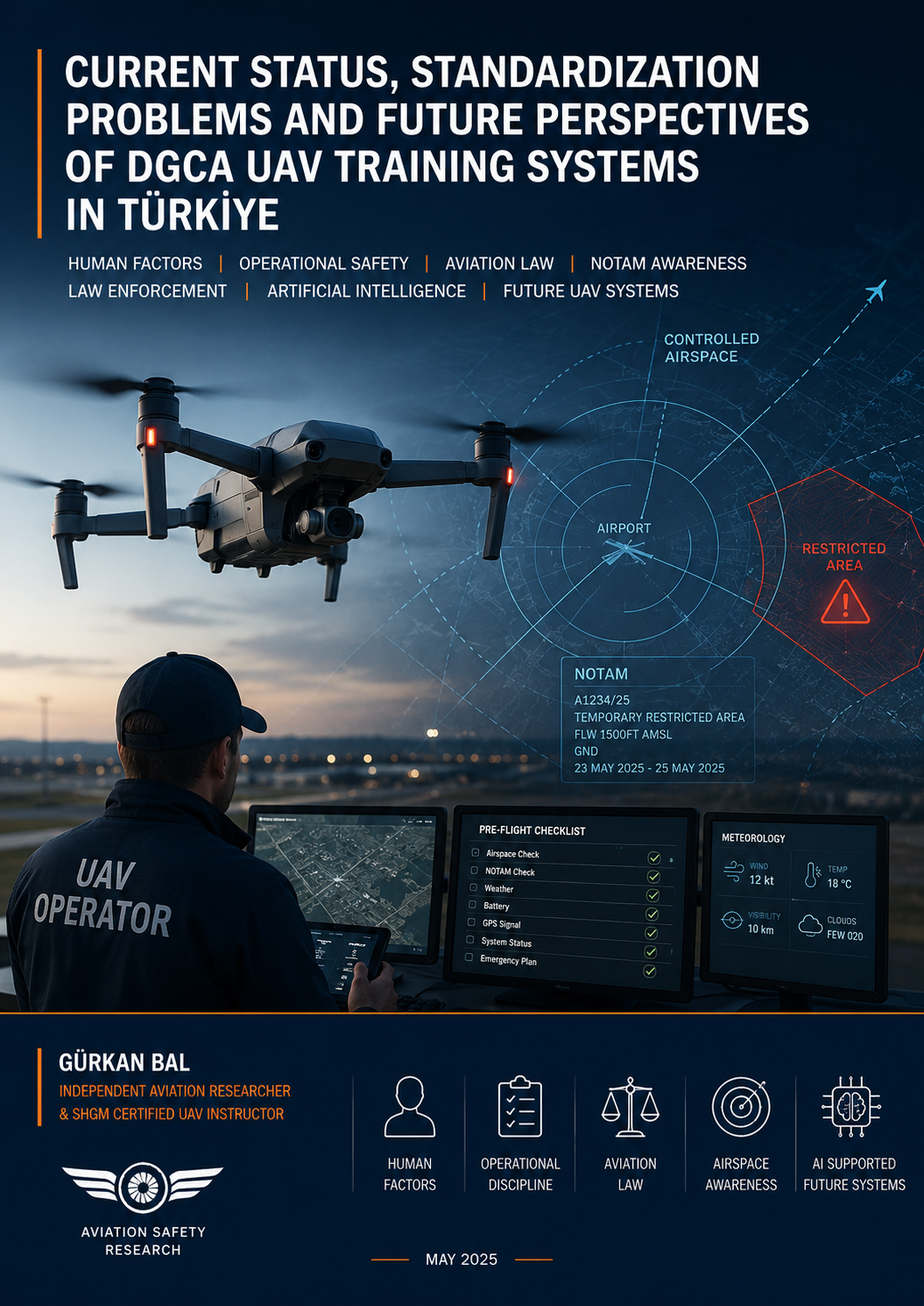
Human Factors • Aviation Law • NOTAM Awareness • Operational Discipline • AI Supported Future Systems
By Gürkan BAL
Independent Aviation Researcher & SHGM Certified UAV Instructor
Introduction
The rapid development of Unmanned Aerial Vehicle (UAV) technologies has significantly transformed the aviation sector worldwide. In Türkiye, UAV systems are now actively used in media, mapping, agriculture, security operations, search and rescue missions, wildfire surveillance, infrastructure inspection, and logistics operations.
As the UAV ecosystem continues to expand, operational safety, aviation law awareness, and pilot training systems have become increasingly important. Today, drone operations are no longer limited to simply controlling an aircraft remotely. UAV operations now require multidisciplinary knowledge including aviation law, meteorology, operational planning, risk management, communication systems, and flight safety culture.
In Türkiye, UAV training systems regulated under the coordination of the Civil Aviation General Directorate have significantly improved in recent years. However, despite these developments, operational observations indicate that important challenges still exist regarding standardization, operational discipline, human factors, and safety awareness.
Human Factors and Operational Risks
One of the most critical issues observed during UAV operations is the human factor.
Field experiences show that many UAV operators demonstrate:
- excessive self-confidence,
- insufficient pre-flight preparation,
- failure to use operational checklists,
- inadequate battery management,
- poor understanding of controlled airspace,
- lack of NOTAM awareness,
- procedural violations during operations.
In many cases, operators act with a “nothing will happen” mentality. This approach creates significant operational safety risks not only for UAV systems but also for other aircraft operating within the same airspace.
Before every UAV operation, the following factors should be carefully evaluated:
- airspace status,
- NOTAM restrictions,
- weather conditions,
- GPS signal quality,
- battery health,
- emergency procedures,
- operational risk assessment.
However, some operators focus solely on launching the drone without considering the broader aviation safety environment.
Within the discipline of Human Factors, excessive self-confidence and procedural non-compliance are recognized as major causes of aviation accidents. Similar trends are increasingly observed in UAV operations.
Aviation Law and NOTAM Awareness
Aviation law awareness is one of the most fundamental components of safe UAV operations.
Operational observations indicate that many users:
- do not fully understand NOTAM systems,
- underestimate flight permission procedures,
- ignore controlled or restricted airspace structures,
- fail to recognize that UAVs share airspace with other aircraft.
This situation creates serious risks, especially around:
- airports,
- military zones,
- critical infrastructure,
- security-sensitive areas,
- wildfire response operations.
UAV pilots must understand that aviation safety is based on discipline, coordination, and airspace awareness.
NOTAM checks and operational planning should become standard habits before every flight operation.
Law Enforcement and UAV Inspections
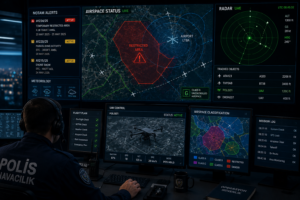
As UAV usage becomes more widespread, law enforcement responsibilities related to drone operations have also increased.
However, operational observations reveal that technical knowledge levels among inspection personnel may vary significantly. Differences in regulatory interpretation and operational procedures can occasionally create inconsistencies in field applications.
For this reason, regular technical seminars and operational awareness programs for law enforcement personnel are critically important.
Inspection personnel should receive standardized training regarding:
- UAV regulations,
- pilot certifications,
- airspace classifications,
- NOTAM procedures,
- operational permissions,
- flight safety principles.
Strengthening coordination between UAV operators and law enforcement authorities will contribute significantly to operational safety.
Artificial Intelligence and Future UAV Systems

The development of Artificial Intelligence technologies is rapidly transforming the UAV sector.
In the near future, AI-supported systems are expected to play major roles in:
- autonomous cargo transportation,
- smart operational planning,
- swarm drone systems,
- wildfire monitoring,
- security operations,
- automated risk analysis,
- advanced search and rescue missions.
As UAV technologies become increasingly autonomous, future training systems will also evolve.
Traditional pilot-centered training models are expected to shift toward:
- system management,
- operational supervision,
- data analysis,
- cybersecurity,
- AI-assisted mission control.
This transformation will require a new generation of UAV professionals with multidisciplinary aviation and technology competencies.
Conclusion
Türkiye’s UAV ecosystem has achieved significant progress in recent years. Training systems coordinated under SHGM have increased aviation awareness among drone operators and contributed positively to the safe growth of the UAV industry.
However, operational observations indicate that important challenges still remain regarding:
- human factors,
- operational discipline,
- checklist culture,
- aviation law awareness,
- NOTAM understanding,
- standardization of inspection procedures.
Excessive self-confidence and insufficient operational preparation continue to create serious aviation safety risks.
For the sustainable growth of the UAV sector, future training systems should focus not only on certification but also on operational safety culture, aviation discipline, risk management, and technological adaptation.
As UAV technologies continue to evolve, strengthening operational awareness and integrating AI-supported next-generation training systems will become increasingly critical for the future of aviation safety in Türkiye.
About the Author
Gürkan BAL
Independent Aviation Researcher, SHGM Certified UAV Instructor, former UAV Operations Officer within law enforcement aviation units, and aviation safety researcher focusing on UAV operations, operational discipline, aviation law, and future AI-supported aviation systems.